From footsteps to fingertips
A smartphone accelerometer, a depth camera, and a wireless receiver appear to have little in common. Yet they share a computational challenge: useful information must be recovered from measurements that are noisy, incomplete, and constantly changing. This early line of my research explored how adaptive models can turn imperfect signals into estimates and interactions people can actually use.
- Mobile Sensing
- Human Interaction
- Computer Vision
- Signal Processing
Consider something as ordinary as walking down a hallway with a phone.
GPS may be unavailable indoors.
The phone measures acceleration, but every step is different.
Walking faster changes step length.
Swinging the phone changes its motion.
Sensor noise adds fluctuations unrelated to movement.
And small errors accumulate with every step.
Estimating a person's trajectory from those signals is an example of pedestrian dead reckoning: determining movement incrementally from sensor measurements rather than continuously relying on an external positioning system.
It sounds simple.
Count the steps. Estimate their length. Add them together.
The difficult part is that neither the step nor its length is perfectly known.
A smartphone as a navigation sensor
Our 2016 Sensors study, Step-Detection and Adaptive Step-Length Estimation for Pedestrian Dead-Reckoning at Various Walking Speeds Using a Smartphone, examined walking-distance estimation using smartphone acceleration signals.
A fixed step length is convenient.
It is also unrealistic.
The same person takes different steps when walking slowly, normally, or quickly.
The study therefore combined signal smoothing, step-detection rules, and an adaptive step-length estimator based partly on walking speed.
A Fast Fourier Transform–based filtering step was used to reduce unwanted components of the acceleration signal before individual steps were identified.
The important idea is adaptation.
Instead of assuming that one calibration works for every walking condition, the estimator changes with the movement pattern being observed.
What if the phone is moving too?
The problem becomes more difficult when the smartphone itself swings with the user's arm.
The 2018 study, Nonparametric regression-based step-length estimation for arm-swing walking using a smartphone, addressed that setting.
Arm swinging changes the acceleration signal measured by the phone, meaning that the sensor records a combination of body locomotion and device motion.
The study modeled step length using relationships involving walking speed and acceleration variability.
Conceptually, this reflects a broader lesson in mobile sensing:
the sensor is not observing the phenomenon from a fixed laboratory position. It is participating in the movement.
The model therefore needs to account for how the sensing device is being used, not merely what it measures.
From estimating movement to understanding gestures
The same principle appears in vision-based interaction.
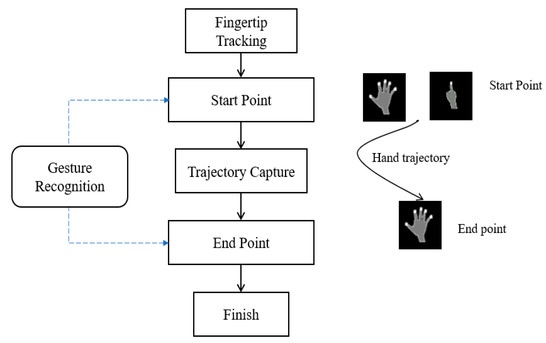
A computer observing a hand gesture must decide which pixels belong to the hand, where the fingertips are, whether the hand is moving intentionally, and which temporal pattern corresponds to a gesture.
RGB cameras provide appearance.
Depth sensors provide distance.
Together, RGB-D data offer complementary information.
The 2020 Applied Sciences study, Real-Time Hand Gesture Spotting and Recognition Using RGB-D Camera and 3D Convolutional Neural Network, combined depth-based hand and fingertip localization with a 3D convolutional neural network for gesture recognition.
The “3D” in this context does not simply mean that the camera senses depth.
A 3D convolution can also learn across the spatial dimensions of image frames and the temporal dimension of a short video sequence.
That is valuable for gestures because movement is part of their identity.
A static frame may show where a hand is.
A sequence shows what the hand is doing.
Turning a fingertip into a mouse
The 2021 Multimedia Tools and Applications study, Real-time virtual mouse system using RGB-D images and fingertip detection, translated this sensing problem into an actual human-computer interface.
Using a Kinect V2 RGB-D sensor, the system identified a hand region, extracted its contour, detected fingertips, and mapped fingertip movement to a virtual screen.
The system operated at 30 frames per second on a desktop computer using a single CPU in the reported experiments.
That implementation detail matters.
An interaction technique is not particularly useful if the user moves a hand and the pointer responds seconds later.
Real-time performance therefore becomes part of the scientific problem rather than an engineering afterthought.
The study also tested conditions such as changing illumination, complex backgrounds, and tracking distance—all situations where a visually elegant demonstration can become much less reliable.
An earlier lesson from wireless signals
An earlier strand of work approached measurement uncertainty from a different domain.
The 2015 Wireless Personal Communications paper, Impact of channel estimation error on the performance of relay selection in cognitive radio networks, analyzed how imperfect channel estimates influence communication performance.
This is separate from the later smartphone and computer-vision pipeline and should not be interpreted as part of one unified sensing system.
But conceptually, it introduced a recurring engineering concern:
algorithms make decisions from measurements, and those measurements are rarely exact.
Ignoring estimation error can make a theoretically strong method fragile in practice.
The same principle later appears in another form in motion sensing and visual interaction, where noise, changing conditions, and imperfect observations must be incorporated into the design.
The thread connecting these projects
At first glance, indoor localization and fingertip interaction seem unrelated.
One follows footsteps.
The other follows hands.
But both require translating continuous, noisy physical signals into discrete computational meaning.
Was that acceleration peak really a step?
How long was the step?
Is that contour point actually a fingertip?
Where should the cursor move?
Has the gesture started?
Has it ended?
The algorithms differ, but the pattern is similar:
sense → filter → represent → estimate → act.
That pattern now appears in much more sophisticated forms across wearable computing, robotics, multimodal AI, and digital health.
From engineered features to learned representations
Modern sensing systems increasingly replace hand-designed processing stages with learned representations.
Smartphones now contain richer inertial sensors.
Depth estimation can be performed with newer camera systems.
Transformers can model long temporal sequences.
Multimodal foundation models can connect image, video, language, audio, and sensor measurements.
But better models do not remove the fundamental questions that motivated this earlier work.
Where does uncertainty enter the system?
How does behavior change the measured signal?
Does the model remain reliable when the environment changes?
And can the algorithm run fast enough to support the human interacting with it?
Those questions are as relevant to today's intelligent systems as they were to step-length estimation or fingertip tracking.
The sensors have changed.
The computational challenge remains remarkably familiar:
extract the right signal from a noisy world, and turn it into something useful.
Related publications
Real-time virtual mouse system using RGB-D images and fingertip detection
Multimedia Tools and Applications 80 (2021), p. 10473-10490 · 2021
Real-time hand gesture spotting and recognition using RGB-D camera and 3D convolutional neural network
Applied Sciences 10.2 (2020), p. 722 · 2020
Nonparametric regression-based step-length estimation for arm-swing walking using a smartphone
IJCCC 13.4 (2018), p. 566-573 · 2018
Step-detection and adaptive step-length estimation for pedestrian dead-reckoning at various walking speeds using a smartphone
Sensors 16.9 (2016), p. 1423 · 2016
Impact of channel estimation error on the performance of relay selection in cognitive radio networks
Wireless Personal Communications 84 (2015), p. 2513-2536 · 2015
Interested in this research?
My current interests center on neuroimaging, trustworthy AI, multimodal learning, and foundation models for biomedical data. I am particularly interested in research that connects methodological development with questions of generalizability, interpretation, population differences, and biological relevance.
If your work intersects with these areas—or if you are a student interested in developing research at their intersection—I would be glad to connect.
Get in touch